
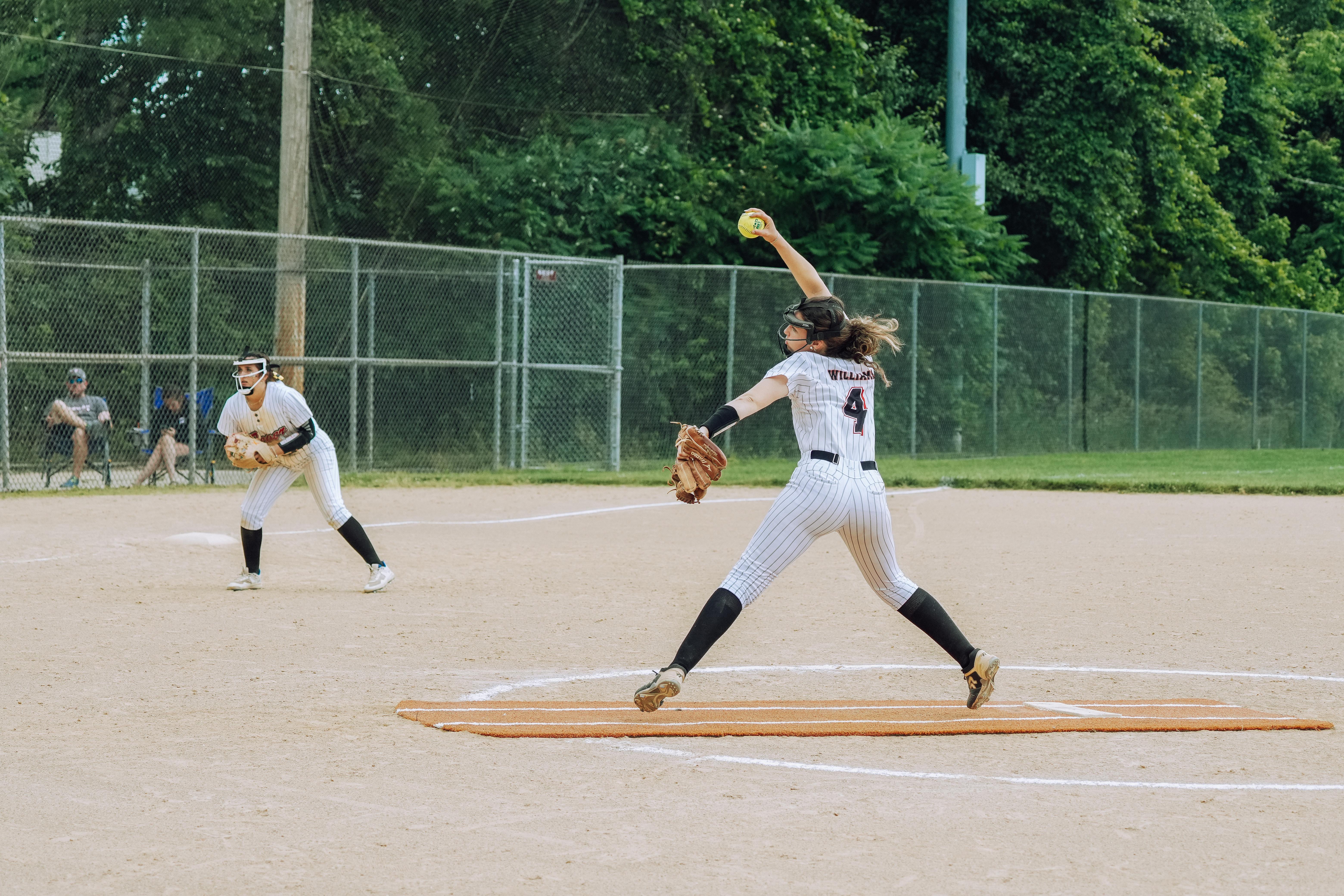
By a Player-Turned-Coach Who Knows the Struggle (and the Payoff)
One of the biggest challenges for softball pitchers is finding enough time—and space—to practice. Between school, work, and team schedules, bullpen time can feel limited. But here’s the good news: some of the most effective pitching drills don’t require a full field or even a catcher. In fact, with the right approach, you can get high-quality reps right in your driveway, garage, backyard, or even inside on a rainy day.
As someone who’s been in the pitcher’s circle for more innings than I can count—and coached athletes from their first windup to their first college offer—I can tell you: consistency is everything. Even 15–20 minutes of focused work at home can make a big difference in speed, accuracy, and control.
Below are five of my go-to at-home pitching drills that build strength, refine mechanics, and sharpen accuracy.
1. The Wrist Snap Drill – Mastering Spin and Control
Why it works:
Your wrist snap is the final “release point” power source for every pitch you throw. If your wrist is loose and controlled, your ball will have better spin, which means sharper movement and more velocity. Without a good snap, even a perfect windup falls flat.
How to do it:
Stand 5–8 feet from a wall or net.
Grip the ball with proper four-seam fastball grip (or your pitch of choice).
Start with your arm bent at 90 degrees and elbow close to your side.
Using only your wrist, “snap” the ball forward into the target area.
Focus on quick, explosive motion—not arm movement.
Coaching tips:
Keep your arm still—let the wrist do the work.
Listen for that “pop” sound against the wall or net. That means you’re getting whip.
Start with 20–30 reps, 2–3 sets per day.
Common mistake to avoid: Flicking the wrist sideways. Your wrist should stay behind the ball and follow straight through toward the target.
2. The K Drill – Building a Strong Release Position
Why it works:
The K Drill locks you into the “power position” (arm up, glove out, stride foot planted) so you can focus on mechanics without worrying about the full windup. It’s a great drill for reinforcing muscle memory and ensuring that every pitch finishes strong.
How to do it:
Stand about 15–20 feet from a net, wall, or target.
Get into your power position—stride foot forward, glove pointing at target, throwing arm straight up like the letter “K.”
Drive your hips forward, pull the ball down, and release with a strong wrist snap.
Follow through naturally, letting your throwing arm finish across your body.
Coaching tips:
Keep your glove arm firm—don’t let it drop too soon.
Push off the back leg to generate power, even without a full windup.
Practice both fastball and changeup grips to improve versatility.
Common mistake to avoid: Rushing the motion. Focus on a smooth pull through the arm circle before release.
3. One-Knee Drill – Isolating the Upper Body
Why it works:
Pitching is a full-body movement, but sometimes isolating one part helps it improve faster. The one-knee drill takes your legs out of the equation so you can fine-tune arm circle mechanics and release timing.
How to do it:
Kneel on your throwing-side knee with your other foot forward (like a lunge).
Place a towel, mat, or cushion under your back knee for comfort.
Hold the ball in your glove in front of you.
Go through a smooth arm circle and release toward a wall or net.
Focus on keeping your shoulders level and your circle consistent.
Coaching tips:
Keep your head still and eyes locked on your target.
Work on hitting the same release spot every time.
Aim for 25–30 throws before switching knees for balance training.
Common mistake to avoid: Leaning forward at release. Keep your torso tall for proper mechanics.
4. Towel Drill – Adding Speed Without a Ball
Why it works:
Throwing a softball over and over can be hard on the arm—especially when practicing daily. The towel drill lets you work on speed and whip without the strain of repeated ball release. It also gives instant feedback on whether your release point is on target.
How to do it:
Take a small hand towel and fold it lengthwise.
Hold it like a softball, gripping one end.
Stand in your normal pitching stance, about an arm’s length from a wall or net.
Go through your full pitching motion. As you “release,” snap the towel so it pops against the wall or target.
Adjust distance so the towel hits the same spot consistently.
Coaching tips:
Focus on speed and whip through the release.
Use the towel to exaggerate arm whip—make it “crack.”
Great for warming up before you even touch a ball.
Common mistake to avoid: Standing too far from the target. If the towel can’t reach, you’ll change your motion unnaturally.
5. Target Challenge Drill – Accuracy Under Pressure
Why it works:
Throwing hard is great, but without accuracy, you’ll rack up walks instead of strikeouts. This drill turns target practice into a competitive game—perfect for self-motivation when practicing solo.
How to do it:
Set up a strike zone target, bucket, or even a cardboard box in front of a net or wall.
Mark smaller “zones” on the target using tape (high/low, inside/outside).
Pick a spot and throw 10 pitches, aiming for that exact location.
Track how many you hit out of 10, then move to the next zone.
Try to beat your score each day.
Coaching tips:
Keep a notebook of daily scores to track improvement.
Use different grips (fastball, changeup, drop) for added challenge.
If you miss, pause and think about why—then adjust before the next throw.
Common mistake to avoid: Just “getting the ball there.” Focus on your mechanics and your aim.
Making the Most of At-Home Practice
A great pitcher doesn’t just throw hard—they throw smart. That means your at-home workouts should be intentional, not just about racking up reps. Here’s how to make sure your practice pays off:
Quality over quantity: It’s better to throw 50 perfect reps than 100 sloppy ones.
Film yourself: Even without a coach present, video feedback can reveal mechanical issues.
Mix it up: Rotate through drills to keep practice engaging and cover all areas of pitching.
Recover smart: Stretch your shoulders, back, and legs after every session to prevent injury.
How Often Should You Practice?
For most pitchers, 3–5 days per week of focused at-home practice works best. On non-pitching days, you can still work on core strength, leg drive, and flexibility—essential parts of your pitching toolkit.
When you’re in-season, shorter, more frequent sessions are ideal to avoid overuse injuries. Off-season is the perfect time for longer workouts focused on refining mechanics.
Final Word from Coach
I’ve worked with pitchers who had all the talent in the world but didn’t practice outside of team workouts—and they plateaued fast. I’ve also coached athletes who started with average speed and control but built themselves into dominant pitchers through consistent, intentional at-home work.
These five drills are core drills because they’re simple, require minimal equipment, and target the core elements of pitching: spin, mechanics, accuracy, speed, and consistency. Do them regularly, track your progress, and watch your performance in the circle transform.
Remember: championships aren’t won on game day—they’re built in the hours you spend practicing when no one’s watching.
Download A Weekly Pitching Plan
Frequently Asked Questions: Pitching Drills & Weekly Plan
What are five effective softball pitching drills for consistent mechanics?
Wall drill (posture/arm circle), K drill (power line and release), One-knee drill (spin focus), Step-through (timing/hips), and Full-circle to target (blend). Use short sets with quality reps and video checks when possible.
How should a weekly pitching plan be structured?
3–4 focused sessions: two mechanics days (drills + short pens), one spin/spot day, and one game-shape bullpen. Add light recovery/mobility between. Keep volume sensible if there are weekend games or tournaments.
How many pitches or minutes per session is ideal?
For developing pitchers, 30–45 minutes or ~60–90 quality pitches is plenty. Prioritize crisp sets (6–10 reps), short rests, and stop when mechanics fade. Quality over quantity builds repeatability and confidence.
Do I need a catcher for these drills?
No. Many drills can be done into a net or tarp with a visible target. Use a catcher for spot work and game-speed bullpens. Mix both to balance mechanics and real-time feedback.
How do pitchers avoid overuse while still improving?
Track weekly volume, rotate focuses (mechanics, spin, locations), and build in active recovery (mobility, light bands). If pain shows up, stop and address it—don’t throw through discomfort. Sleep and hydration matter, too.
What’s a simple pre-throw warm-up for pitchers?
5–8 minutes of dynamic movement (hips, hamstrings, thoracic spine), light band work for the shoulder/scap, then easy wrist/forearm spins and short distance tosses before any full-speed reps.